
Extra virgin olive oil has been the cooking fat of Palestinian, Lebanese, and broader Levantine kitchens for thousands of years - long before the term "superfood" existed. Yet most people in the UAE still treat it as a dressing ingredient, reaching for vegetable oil or ghee the moment a pan goes on the stove.
That's a mistake rooted in an outdated myth, and this guide will dismantle it with practical science, then show you exactly how to cook with zaitoon oil to enjoy healthy meals at home.

How Can You Use Zaitoon Oil in Cooking?
Extra virgin olive oil is one of the most versatile cooking fats you can keep in your kitchen. Here's Macromize brings you healthy uses beyond the salad bowl:
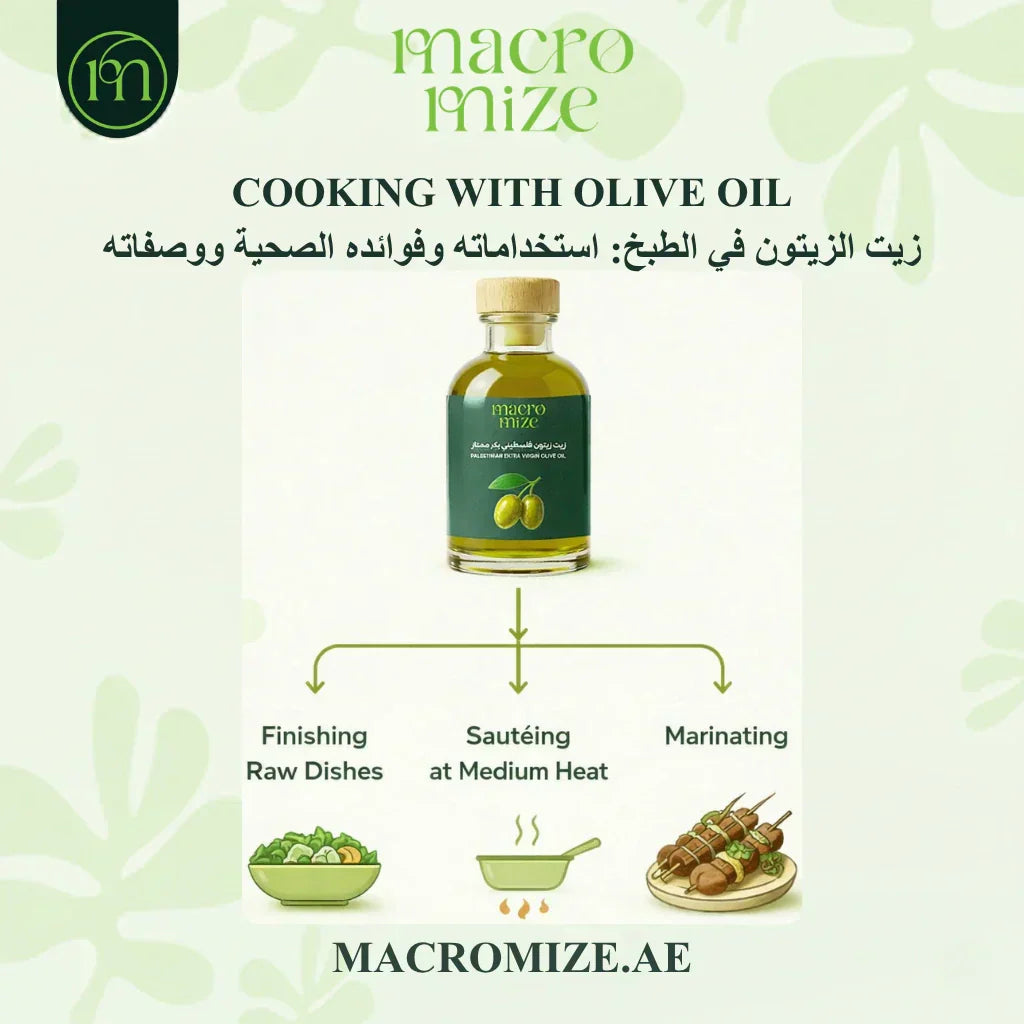
Raw drizzle on finished dishes: The highest-value use of a cold-pressed EVOO like Macromize's Palestinian oil is raw, where zero heat touches the polyphenols.
- Drizzle it generously over fattoush (the sumac-dressed Levantine salad was practically designed for this), hummus just before serving, labneh, mutabbel, mujadara, roasted cauliflower, or warm lentil soup.
- A pool of good olive oil on a plate of plain grilled fish will do more for the dish than any sauce.
Sautéing vegetables, eggs, and spices:
- Medium-heat sautéing - Garlic in olive oil before adding tomatoes
- Gpinach wilted in a tablespoon of EVOO
- Eggs fried until the edges are crisp
Palestinian olive oil has roughly 71% oleic acid, a monounsaturated fat that is chemically resistant to heat-driven oxidation, which is why it stays stable where polyunsaturated-heavy seed oils begin breaking down.
Marinating meats, chicken, and vegetables for the grill: An olive oil marinade does two things:
- It carries fat-soluble aromatics (garlic, herbs, citrus zest, cumin) deep into the protein, and it creates a thin protective layer that slows moisture loss during high-heat grilling.
- Coat chicken thighs, lamb cutlets, or halloumi in Macromize olive oil with crushed garlic, lemon juice, and thyme for at least 30 minutes before the grill.
Baking breads, keto cakes, and desserts: Olive oil substitutes directly for butter or vegetable oil in:
- Bake goods at a 3:4 ratio (we recommend using 3 tablespoons of olive oil for every 4 tablespoons of butter).
- For UAE kitchens, this means you can make olive oil-based kuboos, za'atar flatbreads, or almond-flour keto cakes without touching refined oils. The flavour is subtle at baking temperatures.
Finishing oil for soups and stews:
- Add a tablespoon of Macromize olive oil to a bowl of harira, lentil shorba, or vegetable stew just before serving.
The heat of the soup opens the aromatics in the oil without destroying the polyphenols.
Other everyday applications: Organic Olive Oil is always a multipurpose oil. Emiratis can always experiment with other perceived cooking ideas, like:
- Toss warm pasta or grain bowls in olive oil instead of butter.
- Use it as the base for homemade tahini dressings.
- Mix with pomegranate molasses and walnuts as a muhammara-style dip.
- Blend with roasted garlic as a spread for Macromize's sugar-free Arabic bread.
Is It Safe to Fry or Cook at High Heat with Extra Virgin Olive Oil?
Yes! And the science behind this has shifted significantly in the past decade. For a take-home message, you can scroll down to read where the line part is.
The old warning that EVOO "can't handle heat" was based on smoke point comparisons, typically quoting a figure of 160°C for olive oil. That number is inaccurate for quality EVOO, and more importantly, smoke point turns out to be a poor predictor of what actually matters: whether the oil produces harmful compounds when heated.
A controlled study published in Acta Scientific Nutritional Health heated multiple commercial cooking oils up to 240°C and held them at 180°C for 6 hours. EVOO yielded the lowest levels of polar compounds and oxidative byproducts of all oils tested - lower than canola oil, sunflower oil, grapeseed oil, and rice bran oil - despite not having the highest smoke point.
Research confirms that oxidative stability, not smoke point, is the best predictor of how an oil behaves during cooking.
What gives EVOO this stability? Two things working together. First, its oleic acid content (~71% in Macromize's Palestinian oil) is a monounsaturated fat with a single double bond — far less vulnerable to oxidative breakdown than the polyunsaturated fats in seed oils that have multiple double bonds. Second, the polyphenols native to cold-pressed EVOO function as radical scavengers: they intercept oxidative chain reactions during heating, protecting both the oil and the food being cooked.
Quality EVOO has a smoke point of 190–207°C, which comfortably exceeds all typical home cooking temperatures except very high-heat searing.
Where the line is: Standard sautéing, pan-frying, shallow frying, roasting at oven temperatures, and even occasional deep-frying are all within range. Where EVOO is not ideal is sustained industrial deep-frying at temperatures above 200°C or repeated reuse of the same oil - conditions that don't apply to home cooking.
Practical Implications for Macromize Users: The above scientific arguments are only stated for practical reasonality backed by researchers. Use Macromize Palestinian EVOO freely for everything up to and including pan-frying. Reserve neutral, refined oils only if your recipe genuinely requires sustained ultra-high temperatures or if the robust olive flavour doesn't suit the dish.
How to Incorporate Olive Oil into Everyday UAE Recipes
1. Garlic & Herb Marinade
Combine Macromize Palestinian olive oil with 3–4 crushed garlic cloves, juice of one lemon, dried thyme, and ground cumin. Use it on chicken, fish, or lamb before grilling. The oil carries all the fat-soluble aromatics into the protein. Let it sit for at least 30 minutes; overnight in the fridge is better.
2. Lemon Vinaigrette for Fattoush and Green Salads
Whisk 3 tablespoons of Macromize olive oil with 1 tablespoon of fresh lemon juice, half a teaspoon of sumac, a pinch of salt, and a small amount of Macromize apple cider vinegar if you have it. This combination — olive oil lemon dressing — is one of the most clinically validated flavour pairings for nutrient absorption, as the oil's fats dramatically increase the bioavailability of fat-soluble antioxidants in the salad's vegetables.
3. Za'atar and Olive Oil Dip
Pour Macromize Palestinian olive oil into a small plate and stir in 2 teaspoons of za'atar (dried thyme, sumac, sesame). Use as a dipping sauce for Macromize's sugar-free Arabic bread. This combination — ubiquitous in Palestinian and Levantine breakfast culture — delivers monounsaturated fats, thymol from the za'atar, and polyphenols from the oil in a single bite.
4. Olive Oil Balsamic Dip
Combine olive oil with a few drops of aged balsamic vinegar and a crack of black pepper. Simpler and sharper than za'atar; pairs well with sourdough or any rustic flatbread.
Healthy Cooking Swaps for UAE Kitchens
- Replace vegetable oil in musakhan (the Palestinian spiced chicken on taboon bread) with Macromize olive oil. It belongs there by tradition.
- Use olive oil instead of ghee when making rice-based dishes where you want a lighter result without losing richness.
- Replace butter in keto baking (almond flour cakes, low-carb cookies) with olive oil at a 3:4 ratio.
- Use a tablespoon of olive oil instead of cream when finishing mashed root vegetables.
What Are the Health Benefits of Cooking with Olive Oil?
It Provides Heart-Healthy Monounsaturated Fats That Replace Harmful Ones
The cardiovascular case for olive oil is only valid when it substitutes for less healthy fats - not when it is simply added on top of them. Olive oil contains mostly monounsaturated fat, linked to lower levels of LDL ("bad") cholesterol, reduced blood pressure, and protection against harmful inflammation. These benefits are realized when EVOO is used as the primary cooking fat in a diet, replacing butter, seed oils, or animal fats.
It Contains Over 20 Types of Polyphenols
EVOO contains more than 20 types of polyphenols - plant-based compounds that help protect the heart and reduce systemic inflammation. These are the primary source of its documented health benefits. Polyphenols also function as antioxidants in the body, neutralizing free radicals that accelerate cellular aging and contribute to chronic disease.
Oleocanthal: The Natural Anti-Inflammatory in Every Bottle
One polyphenol in EVOO deserves specific attention because of what research has found about how it works. Oleocanthal shares unique perceptual and anti-inflammatory characteristics with ibuprofen. Research clearly shows that oleocanthal inhibits cyclooxygenase 1 and 2 (COX 1 & COX 2) enzymes in a dose-dependent manner, mimicking the anti-inflammatory action of the synthetic NSAID ibuprofen, and at equimolar concentrations, oleocanthal inhibits 41–57% of COX activity compared to ibuprofen's 13–18%.
That peppery sting you feel at the back of your throat when you taste high-quality, fresh EVOO? That sensation is oleocanthal. It's exactly why refined olive oil tastes flat - the refining process strips it out along with the other polyphenols. Macromize's cold-pressed Palestinian olive oil is unrefined, so it retains this compound intact.
Zero Carbs, Zero Sugar - Genuinely Diabetic-Friendly
Olive oil adds no carbohydrates, no sugar, and no glycaemic load to any dish. For health-conscious eaters in the UAE managing blood sugar, insulin resistance, or following a low-carb or keto approach, cooking with olive oil instead of starchy thickeners or high-carb condiments actively supports metabolic health goals. The monounsaturated fat in EVOO has also been studied for its role in improving insulin sensitivity.
Anti-Inflammatory at the Population Level
Research has linked olive oil-based diets to lower systemic inflammation and better cholesterol profiles. A 2022 study spanning 28 years found that high olive oil consumption was associated with an 8–34% lower risk of disease-related death. Specifically, people who consumed the most olive oil were 19% less likely to die of cardiovascular disease and 17% less likely to die of cancer than those who consumed the least.
Selecting the Right Olive Oil for Cooking?
Not all olive oils are the same category of product. The grading system matters because it determines what's actually in the bottle.
Extra virgin means the oil was produced from the first mechanical press with no heat, no chemical solvents, and with free fatty acid content below 0.8% - a sign of freshness and correct handling. Macromize's Palestinian olive oil meets this standard. Refined olive oil, "pure" olive oil, and "light" olive oil are lower-grade products that have been processed using heat or chemical treatment, stripping out most of the polyphenols and much of the flavour.
EVOO is the least processed version - the closest thing to freshly pressed oil. No other grade of olive oil can provide as many documented health benefits.
Cold-pressed means the extraction temperature was kept low during pressing, preserving heat-sensitive polyphenols, vitamins, and flavour compounds that are destroyed or reduced if heat is applied to speed up the process. This is why Macromize's oil has a distinct peppery, grassy finish — those notes come from the bioactive compounds that a heat-processed oil would have lost.
Single-origin Palestinian matters beyond marketing. Blended supermarket olive oils combine oils from multiple countries, different harvest dates, and varying storage conditions. The result is a product calibrated for price and shelf life, not polyphenol density or flavour integrity. Macromize's oil comes from hand-harvested olives in the historic West Bank groves. A region where olive cultivation predates modern agriculture - cold-pressed within hours of harvest. That provenance is directly connected to the oil's flavour and nutrient profile.
FAQs About Cooking with Olive Oil
Can I reuse olive oil after frying? We do not recommend. This applies to all cooking oils - not just olive oil. Each heating cycle degrades polyphenols and increases the concentration of polar compounds (oxidation byproducts). Reusing oil for frying compounds this effect rapidly. Use fresh oil each time, and if you're using EVOO for shallow frying (not deep frying), the amount used is typically modest enough that waste is not a real concern.
Does olive oil make food greasy? Only if you use too much. Olive oil has the same caloric density per gram as any other fat - the difference is that because cold-pressed EVOO has a more assertive flavour, you often need less of it to achieve the desired result. For sautéing, 1–2 tablespoons is usually sufficient. For dressings, 1 tablespoon per two servings is a reasonable starting point. The greasiness people associate with inferior cooking is usually from low-quality, refined oils that lack flavour intensity and require more volume to taste like anything.
What dishes pair best with olive oil? Any dish from the Mediterranean or Levantine tradition - fattoush, hummus, tabbouleh, musakhan, mujadara, grilled fish, roasted lamb, shakshuka, lentil soup. It was developed around olive oil as the primary fat. Beyond these, olive oil works in any dish where you want richness without the heaviness of butter, or flavour depth without the neutrality of vegetable oil. It works particularly well with acidic ingredients (lemon, tomato, vinegar) because the fat carries and amplifies those flavours.
How to store olive oil to keep it fresh? Three factors degrade olive oil: light, heat, and oxygen. Store your Macromize Palestinian olive oil in a dark, cool place away from the stove. The dark bottle matters - UV light accelerates oxidation. Do not store it next to the hob or in direct sunlight. Once opened, use within 4–6 weeks for peak flavour. Do not refrigerate; condensation inside the bottle can introduce moisture that accelerates spoilage.
Is olive oil good on an empty stomach? Yes, and there's a specific clinical interest Macromize EVOO serves in this practice. Taking 1–2 tablespoons of EVOO first thing in the morning, before food, may support bile flow, gut motility, and the slow release of oleocanthal and other polyphenols without the competition of other nutrients in a full meal. It's a practice with roots in traditional Palestinian and Mediterranean daily life. If you're new to it, start with one teaspoon and increase gradually.
Which Olive Oil Is Best for Cooking?
For cooking in the UAE, you want an extra virgin, cold-pressed oil with verifiably low acidity (below 0.8%), single-origin provenance, and no additives or blending. These factors directly correlate with polyphenol content, which is what determines both cooking stability and health value.
Macromize Organic Palestinian Extra Virgin Olive Oil meets every one of these criteria. It is cold-pressed, unrefined, certified organic, sourced from single-origin Palestinian family farms, and delivered fresh across Dubai and the UAE. It's the kind of oil that still has the throat-sting of oleocanthal - the sign that the bioactive compounds are intact.
Use it freely. Cook with it. Drizzle it. Let it replace the vegetable oil and refined fats currently taking up space in your kitchen.
Share:
Zaitoon Oil Uses and Benefits: Emirati Guide to Extra Virgin Olive Oil
Zaitoon (Olive) Oil for Skin: Safe Uses, Benefits & Practical Tips for Emiratis