
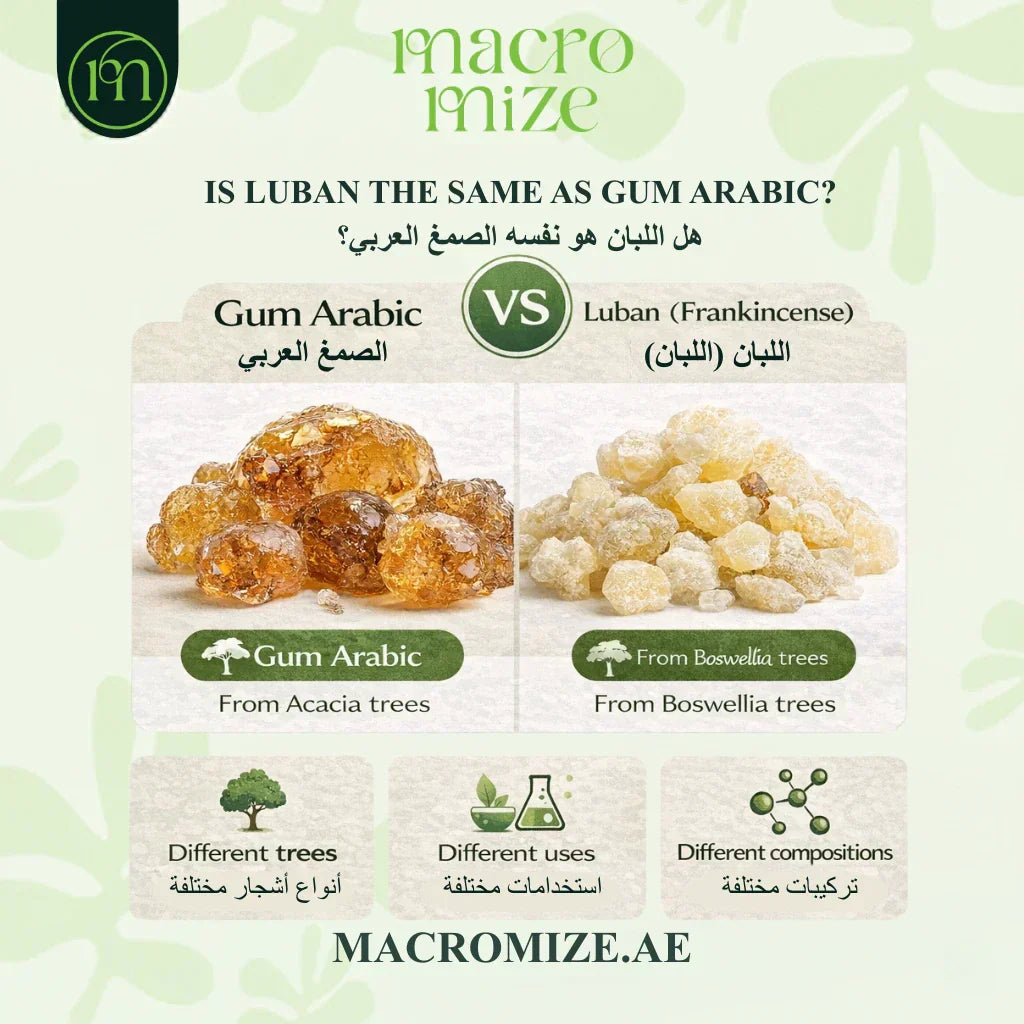
Is Luban the Same as Gum Arabic? Clear Differences Explained
No, Luban (frankincense) is not the same as gum Arabic. Many people search for terms like Luban Arabic gum, frankincense Arabic gum, or Arabic mastic gum, assuming these are the same product. In reality, they are completely different natural substances that come from different trees, belong to different plant families, and are used for different purposes.
Gum Arabic comes from Acacia trees and is commonly used as a food stabilizer and soluble fiber. Luban (frankincense) comes from Boswellia trees and is primarily used as incense or aromatic resin.
They come from different plant families, have different chemical compositions, and serve completely different purposes. As gum arabic, luban (frankincense), mastic gum, and acacia are all plant resins or gums from the Middle East and Africa, the confusion is understandable. However, they are not interchangeable.
This guide clearly explains the differences so you can confidently choose the right product for a healthy UAE lifestyle.
What Is Gum Arabic?

Gum arabic is a natural, edible gum obtained from certain Acacia trees, mainly Acacia senegal and Acacia seyal. It is commonly used as:
-
A food stabilizer
-
A natural thickener
-
A soluble fiber source
-
A beverage ingredient
Gum arabic dissolves easily in water and is widely used in food products, drinks, and baking. It is sometimes called acacia gum, which adds to the naming confusion.
If you'd like a full breakdown, read our → What Is Gum Arabic?
What Is Luban (Frankincense / Boswellia)?
Luban is the Arabic word for frankincense, a natural aromatic resin that has been valued for thousands of years across the Middle East, North Africa, and parts of Asia. If you are wondering what the English name for luban is, it is simply frankincense.
Despite frequent online search terms such as “luban arabic gum” or “frankincense arabic gum,” frankincense is not the same substance as gum arabic.
The confusion arises because both are natural tree resins sold in similar regions, but botanically and functionally, they are completely different products.
The Boswellia Tree
Frankincense comes from trees belonging to the Boswellia family, not from Acacia trees. The most well-known species include:
-
Boswellia sacra – commonly found in Oman and Yemen
-
Boswellia carterii – native to Somalia
-
Boswellia serrata – primarily found in India
When the bark of these trees is carefully cut, a milky resin seeps out and hardens upon exposure to air, forming small golden or amber-colored tears. These hardened resin pieces are what people refer to as luban.
Historically, frankincense was one of the most valuable trade commodities in the ancient world and was transported along major trade routes throughout Arabia and beyond.
What is Luban Used for in Islam?
In many Muslim communities, luban (frankincense) is valued for its fragrance rather than as a religious requirement. In Islam, cleanliness and pleasant scent are strongly encouraged, especially before prayer and on special occasions such as Jumu'ah (Friday prayer), Eid, and weddings. Burning incense, including frankincense, is therefore a cultural practice aligned with maintaining a clean and welcoming environment.
It is important to clarify that frankincense itself is not mandatory in Islamic worship, nor is it prescribed as a specific ritual substance in the Qur’an.
Rather, its use developed culturally across regions such as the Arabian Peninsula, East Africa, and parts of South Asia, where frankincense trees naturally grow and trade historically flourished.
Use in Homes and Mosques
In many Middle Eastern households, frankincense is burned:
-
To fragrance the home before guests arrive
-
After cooking to refresh the indoor air
-
During religious gatherings or Qur’an recitation
-
In mosques before congregational prayers
The smoke is believed culturally to create a calm and purified atmosphere. In some regions, incense burners are passed around so that individuals can lightly scent their clothing.
Spiritual and Cultural Beliefs
Across different cultures, some families associate burning luban with:
-
Creating a peaceful spiritual environment
-
Marking special religious nights (such as Ramadan evenings)
-
Personal reflection and supplication
However, these practices are cultural traditions rather than formal religious obligations. Islamic teachings emphasize intention and worship rather than specific aromatic substances.
Drinking or Chewing Luban
In certain regions, particularly in Oman, Yemen, Somalia, and Sudan, small pieces of frankincense may be:
-
Soaked in water overnight and consumed in small amounts
-
Chewed like natural resin
Overall, Luban’s primary role in Islamic societies has been aromatic and cultural. It is burned for its distinctive scent and symbolic atmosphere, not used as a food ingredient.
Gum Arabic vs Luban – Key Differences
To make it easier to understand, here’s a comparison of gum Arabic (acacia gum) and luban (frankincense / Boswellia). While both are tree resins, they differ completely in source, taste, texture, and use:
|
Feature |
Gum Arabic |
Luban (Frankincense) |
|
Source Tree |
Acacia trees |
Boswellia trees |
|
Plant Family |
Fabaceae |
Burseraceae |
|
Taste |
Mild, neutral |
Bitter, resinous |
|
Common Use |
Food stabilizer, drinks, baking |
Incense, fragrance, traditional chewing |
|
Form |
Powder or gum crystals |
Hard aromatic resin tears |
Important Clarification
-
Is luban the same as arabic gum? → No.
-
Is gum arabic frankincense? → No.
Luban arabic gum benefits and gum arabic benefits refer to two different substances. They may both be natural resins, but they are not interchangeable in food or traditional uses.
Gum Arabic vs Mastic Gum
Another product that is often confused with gum Arabic is mastic gum. While the names can overlap in regional markets, mastic gum comes from a completely different tree and has unique properties and uses.
Source and Botanical Background
Mastic gum is harvested from the Pistacia lentiscus tree, which grows mainly in the Mediterranean region, especially on the Greek island of Chios. In Arabic, it is sometimes called mastika or Arabic mastic gum, which can lead to confusion with gum Arabic. Botanically, it is unrelated to Acacia trees or Boswellia (luban), making it a distinct natural resin with different functional and culinary properties.
Taste, Texture, and Culinary Uses
Mastic gum has a pine-like, slightly resinous flavor, which gives Middle Eastern desserts, ice creams, and confections their characteristic aroma. Unlike gum Arabic, it is chewy and does not dissolve completely in water, which makes it unsuitable as a beverage stabilizer or thickening agent. Its primary uses are in chewing resins, pastries, and traditional sweet recipes rather than smoothies, syrups, or sauces.
Key Differences
-
Flavor: Pine-like and aromatic vs. neutral and mild for gum Arabic
-
Texture: Firm and chewy; does not dissolve vs. smooth, water-soluble gel
-
Use in Foods: Desserts, chewing resin, pastries vs. stabilizer for drinks, sauces, and baked goods
-
Geography: Mediterranean region vs. Africa and the Middle East
If you’ve been searching for “Arabic mastic gum” or “mastic gum in Arabic,” it’s important to recognize that this is a different resin altogether. Unlike gum Arabic, mastic gum cannot dissolve smoothly into liquids, and it serves very different culinary and traditional purposes.
Botanical Classification of Gum Arabic, Luban and Mastic Gum
Although gum Arabic, luban, and mastic gum are all tree exudates, they belong to entirely different botanical families:
• Gum Arabic – Acacia species (Fabaceae family)
• Luban – Boswellia species (Burseraceae family)
• Mastic – Pistacia lentiscus (Anacardiaceae family)
This botanical distinction explains why their chemical composition, solubility, taste, and practical applications differ so dramatically.
Understanding the plant origin helps prevent misuse in cooking, supplementation, or traditional applications.
So Which One Should You Choose?

If your goal is:
| Goals |
Gum Arabic (Acacia Gum) |
Luban (Frankincense / Boswellia) |
Mastic Gum (Pistacia lentiscus) |
|
Stabilizing drinks |
Dissolves easily; keeps juices, smoothies, coffee, and herbal infusions uniform |
Won’t dissolve; not suitable |
Won’t dissolve; not suitable |
|
Improving smoothie or sauce texture |
Smooth, neutral texture; slight viscosity without affecting flavor |
Bitter and resinous; not food-friendly |
Can add chewiness or texture in specialty recipes |
|
Baking/making sauces |
Works in batters, icings, glazes, and sauces |
Not recommended |
Can flavor Mediterranean desserts; adds chewiness |
|
Adding soluble fiber |
Provides gentle, water-soluble fiber |
No fiber; primarily aromatic resin |
Minimal fiber; mainly flavor and chewiness |
|
Thickening syrups or jams |
Helps maintain uniform texture |
Not suitable |
Can slightly help, but flavor is dominant |
|
Homemade candies or gummy treats |
Ideal for smooth texture and binding |
Not suitable |
Adds chewy texture and unique flavor |
|
Gluten-free or vegan recipe binding |
Works well as plant-based binder |
Not suitable |
Limited binding; mainly flavor |
|
Incense / aroma |
Neutral; not aromatic |
Traditional incense in homes, mosques, and rituals |
Mild aroma; rarely used as incense |
|
Traditional chewing resin |
Not chewy or aromatic |
Culturally chewed in some regions |
Commonly chewed in Mediterranean cultures |
|
Fragrance for cosmetics or oils |
Neutral; only functional |
Used in perfumes, oils, and aromatic preparations |
Slightly aromatic; limited use |
|
Specialty desserts / pine-like flavor |
Neutral flavor |
Bitter; not used in culinary |
Ideal for ice creams, pastries, and sweets |
|
Cultural or religious rituals |
Functional only |
Central to rituals, offerings, and symbolic use |
Rare; mostly culinary |
They are not substitutes for one another. For detailed nutritional information on Gum Arabic, read → Gum Arabic article.
Why This Confusion Is Common in the Middle East
In the UAE and across the Gulf region, terms like "luban Arabic gum" are commonly used in marketplaces and online searches. Because these resins are sold in similar stores and often displayed together, shoppers naturally assume they are interchangeable.
However, despite overlapping regional terminology, gum Arabic and luban serve entirely different culinary and cultural purposes.
Why Gum Arabic Is the Right Choice for Food and Beverage Use
If your goal is to improve smoothie texture, stabilize drinks, or add gentle soluble fiber to your diet, gum Arabic is the only suitable option among these resins.
Unlike Luban or mastic gum, gum Arabic:
• Dissolves completely in water
• Has a neutral taste
• Does not alter flavor profiles
• Works in both hot and cold applications
• Acts as a natural plant-based stabilizer
For modern kitchens focused on clean ingredients and functional nutrition, gum Arabic offers practical benefits that aromatic resins simply cannot provide.
Conclusion
Understanding the differences between gum Arabic, luban (frankincense), and mastic gum is essential before making a purchase. While all three are natural tree resins, they serve very different purposes.
If your goal is to enhance recipes, smoothies, baked goods, or drinks with a clean, functional ingredient, gum Arabic is the clear choice. Its versatility, mild flavor, and soluble fiber make it an indispensable addition to any modern kitchen, whether you are a busy professional, a health-conscious parent, or a culinary enthusiast.
By choosing gum Arabic, you are selecting a practical, natural ingredient that integrates seamlessly into everyday cooking and baking - delivering consistent texture, stability, and subtle nutritional benefits.
For a high-quality, easy-to-use option, explore our premium gum Arabic products and make functional nutrition a natural part of your daily routine. Don’t get confused by similar-sounding resins. Choose the right product for your needs and enjoy the benefits that gum Arabic can bring to your food and beverages.
Macromize Gum Arabic is selected for purity, consistency, and performance. Explore Macromize Premium Gum Arabic and experience the functional quality you can rely on.
Frequently Asked Questions
Is Luban healthy?
Luban (frankincense / Boswellia) is traditionally used in cultural practices. However, it is not the same as gum arabic, and its uses differ significantly.
Is Luban the same as acacia gum?
No. Luban comes from Boswellia trees. Acacia gum (gum arabic) comes from Acacia trees.
Is frankincense edible?
Frankincense (luban) may be chewed or soaked in water in some cultures, but it is not used as a food stabilizer or thickening agent like gum Arabic.
Can you cook with luban?
No. Luban does not dissolve properly in food or beverages and has a bitter, resinous taste that makes it unsuitable for cooking.
What is the difference between Arabic gum and frankincense?
Arabic gum (gum Arabic) is water-soluble and used in food applications. Frankincense (luban) is an aromatic resin used primarily for incense and fragrance.
Share:
Gum Arabic Powder – How to Use It in Food, Drinks & Painting Crafts
Buying Gum Arabic Online in UAE – Price, Quality & Suppliers Guide